
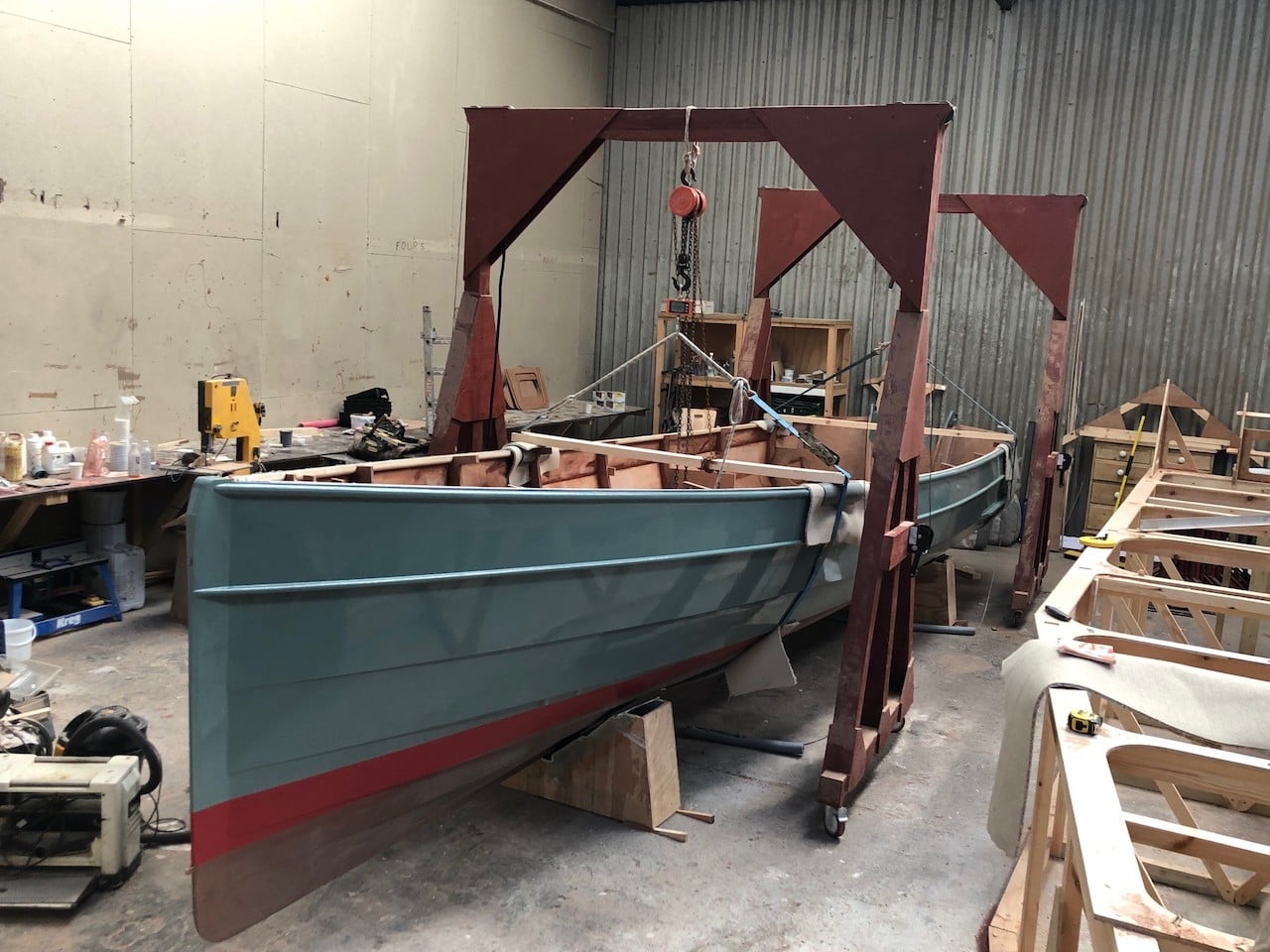
Well, most launchings are usually quite an event in themselves – on a certain day and hour, and witnessed by the press, but ‘CLARA’ (GP8 No. 1) has been unceremoniously pulled in and out of the water quite a few times over the past three weeks – and the only words spoken have been between us as we work on various tweeks and re-launch her to test them.
Getting the weight right is especially important on these boats so we were happy to weigh CLARA in, ready to launch, at 880 kgs (1940 lbs).
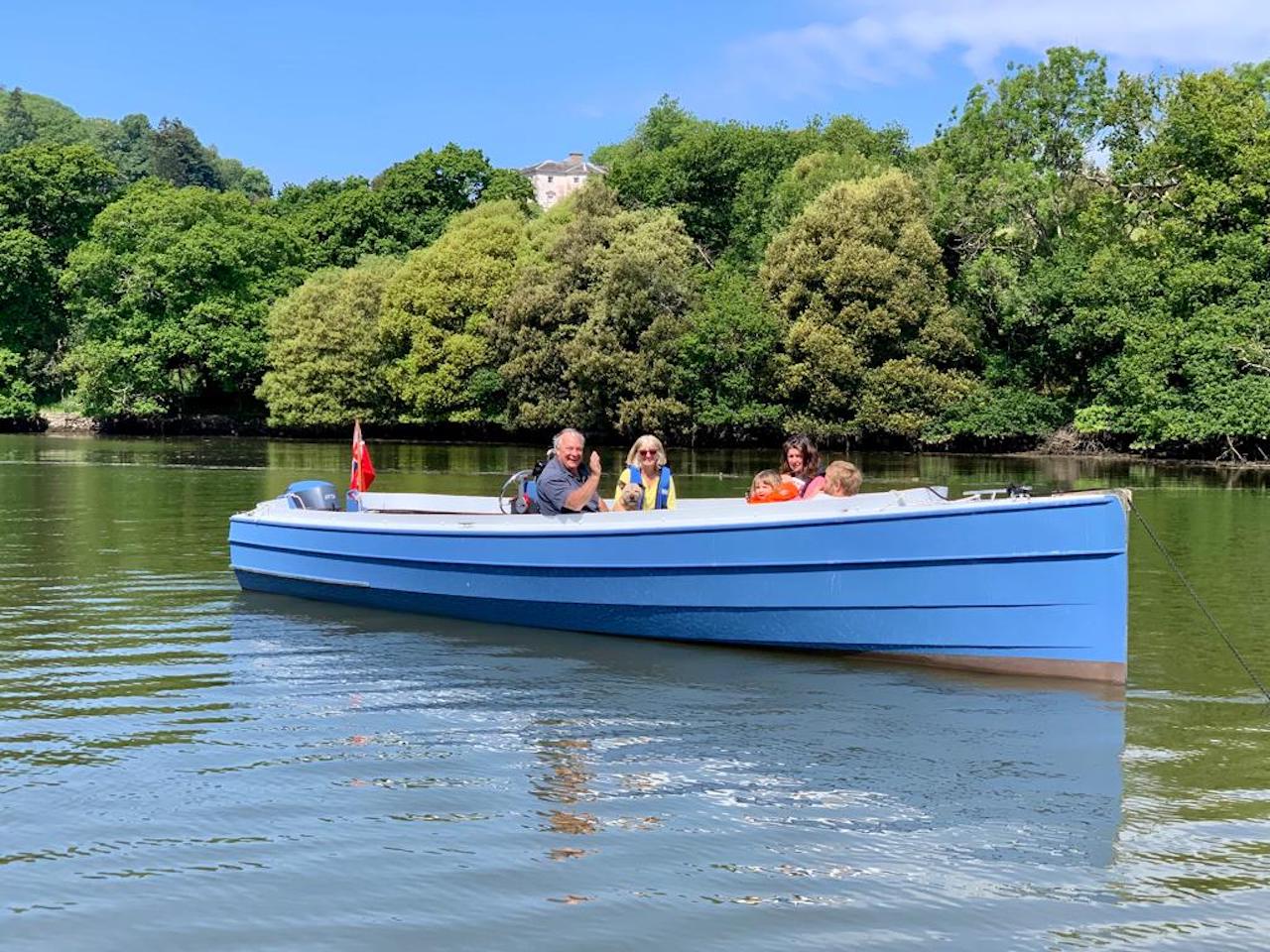
In the meantime, GP8 No. 2, ‘TUTTI’ has been afloat for 7 weeks now, and her owner, Richard Ayers, has been sliding up and down the River Dart like a Yo-Yo – as anyone else would have been at this time of year (more later about Richard Ayers, who has played an important role in this project …).
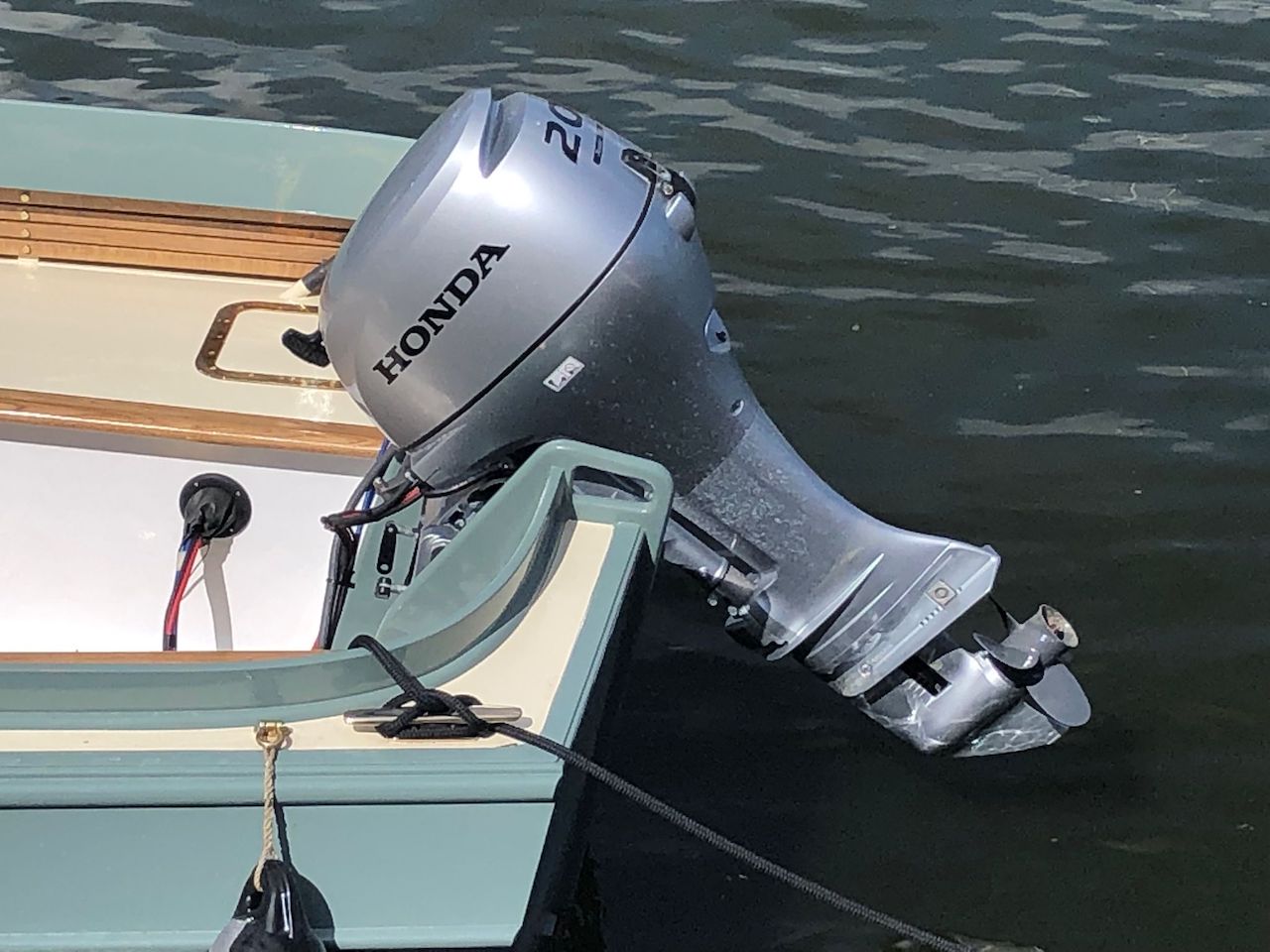
The main reason why CLARA was always going to be powered by an outboard was to allow free choice to subsequent owners about which engine to fit, how much power they want and (most importantly) whether to go down the conventional gasoline-powered outboard route or explore the exciting possibilities offered by electric power.
In the stampede to produce better electric powered engines it’s also likely that existing models will soon become obsolete, and upgrading an outboard is much easier for a boat owner than doing the same with an inboard engine.
GB8 No.3 (‘FARADAY’) is owned by Richard Stilgoe (who has previously owned 5 different boats designed by us). He has been an avid supporter of electric propulsion over the years and his research in the field has been useful as we apply it to the CLARA design.
The hull was ready to be turned right-side up in our workshop since February but Richard chose to put the build work on ‘hold’ because mixing often rather dubious claims about powering, speed and range with the equally un-tested ‘real life’ characteristics of ‘CLARA’ left us with insufficient data to justify ploughing ahead with work on his boat.
Part of the benefit of building a string of near-identical boats, however, is that we were able to call up some useful help from the UK importers of ePropulsion who came down equipped with a 6kw electric outboard (Navy 6.0 Evo), together with one of their E175 9kWh batteries. We were all (including Richard himself) able to witness how the installation would perform.
First tests of the ePropulsion set-up using ‘CLARA’ as a guinea-pig’ (with the 20 hp HONDA going along for the ride – on a bench !)
The fact that the power/speed curve of CLARA is almost a straight line (so no ‘hump’ involved) makes the design very well adapted to electric drive and all of us who went on a test ride were impressed by the sensation of traveling up to 8 knots in almost perfect silence – with only the sound of water sliding past the hull….
The Big Challenge however with any electric propulsion installation is that for the time being the energy-density of the best battery available is still really poor compared to that of a can of gasoline or diesel of the same weight.
In our case Richard Stilgoe had always expressed his intention to expect a 70 nm range at a speed of 7 knots. As a result of the data gathered during the test run this does seem achievable, but, doing so involves the installation of 4 x E175 9kWh batteries. Each one of which weighs 87 kg (192 lbs), so all four clock in at 348 kgs (767 lbs.)
If you take the gasoline-powered ‘CLARA’ and subtract the 20hp Honda outboard, together with a battery and the fuel for the same range at the same speed you would have extracted less than 100 kgs (220 lbs), so the Electric boat will be carrying some 248 kgs (547 lbs) more than the Gasoline one.
If the two boats are traveling at the same speed the Electric one will need more power to maintain that speed because it is heavier and (for what it’s worth) the Electric one will not reduce weight along the way either!
I don’t pretend that the maths above is super-accurate but if any CLARA owner likes to travel 100 mile passages in these small boats (we do!) then it’s hard to justify the electric choice – especially as re-charging points are not necessarily easy to find in many places. That said, once anyone has experienced the silence offered by an electrically driven boat it’s hard to go back…
It’s worth adding that in our experience boats cruising at 8-10 knots for, say, a couple of hours (typical CLARA cruise speed/range) will find the inevitable noise and vibration coming from a the 20 hp gasoline engine becomes relatively more intrusive than is the case on a 35 knot planing-hulled boat with a 200 hp engine that is only running for a short ‘sprint’ time in which the noise comes mainly from wind and spray.
As a way of levelling the battery/gasoline choice we’re looking into ways to reduce gasoline outboard noise emission. It’s surprising for a start that the hood of most of these models don’t seem to offer any noise-reducing material.
We’re also testing low-pitch propellers – which are normally sold for pushing harbour craft around. As a result they run at higher revs in the higher power range but the torque is relatively low. Over the years we’ve been surprised to find that a higher rev engine that achieves its power at lower torque is easier to live with. We’ll report back !