
Hi-
In the following text I’ve set out to compare the advantages and disadvantages between planing-hulled boats and the low-displacement slender hull-forms we’ve been developing over the last two decades.
This debate has taken a new turn in recent years in response to a world-wide interest in replacing fossil fuels with electric power wherever possible. No doubt the ground will be moving under our feet as this technology develops, but we believe our LDL hull-type offers the best platform for this development and look forward to harnessing this exciting technology as it develops..
Not many people will find the text below about this subject a great read, but I hope it will serve as a ‘textbook’ that can be visited now and then among the lighter stuff about the nuts and bolts of how our boats are conceived, built – along with what we have learned from them on the water.
NIGEL IRENS
HULL DESIGN FOR ELECTRIC PROPULSION IN SMALL CRAFT
-
A Difficult Compromise?
i) While those concerned with the development of battery-powered boats strive to achieve optimum performance there seems to be an assumption that the boats into which the new equipment is to be installed should continue to be a Planing-Hulled
ii) Planing Hulls were, of course, originally developed to be driven by internal-combustion engines and over the past hundred years or so they have always been the standard solution.
iii) The snag in trying to use a Planing -Hull when a battery powered electric drive is envisaged is that the energy density of the batteries that provide power is very much lower than that of the fossil-based fuel powering the combustion engines.
iv) The result is that existing battery-powered boats often struggle to get on the plane, labouring under the double handicap of less power and more weight.
v) To address that problem the only solution using battery power is to seek out ever lighter and more sophisticated battery bank – and put as many of them as possible on board, which inevitably winds up both the weight and the cost of the finished item.
vi) The whole point of seeking out alternative energy sources is, of course, to try to reduce emissions, but even Lithium mining is not without its environmental downsides – so using more of it than is needed starts to head you off back down a wrong turning.
vii) The bottom line is that you might end up with a very expensive boat that still doesn’t really capture the true excitement offered by an average off-the-peg gasoline-powered flyer. Trying to keep everybody happy by pulling together an awkward compromise solution (in any field of activity) has rarely made much commercial sense.
viii) Perhaps it’s time to face reality and create a Fork in the Road ahead, so accepting that the existing fossil-fuel powered boat optimised for high speed planing carries on serving the vast majority of owners, while those interested in low energy ‘medium speed’ boating can enjoy the pleasure of boats specifically optimised for that role.
ix) This is not about competing with Planing Hulls, but more about offering more meaningful choices for more people
-
Plan B – A Well-Proven Solution:
i) Over the past years Nigel Irens Design (NID) has been working on some answers in this domain: In 2003 we set about designing and building a ‘medium speed’ 12m (39ft) motor cruiser, called RANGEBOAT, that was purposely configured not to plane as the power was increased.
ii) This family of hulls is designed to explore the territory that lies beyond the speed capability of a displacement hull and yet below that of a Planing-Hull – once properly on the plane. In the following years The RANGEBOAT was built as a production boat, of which 16 were built.
iii) RANGEBOATS displace some 5 tonnes and are fitted with a single 100 hp engine which will propel the boat to about 15-16 knots (12.3-13.1 equivalent in ‘CLARA’/’GRETA’). In reality, though, most owners tend to settle for a long-range cruising speed of some 12 knots on a RANGEBOAT. At this speed they consume about .85 litres (.225 US gal.) of diesel fuel per nautical mile (so say 85 litres (22.5 US gal.) for a typical 100 nautical mile passage).
iv) The principles behind the hull shape on these boats are quite simple, with fine waterlines forward and a relatively wide waterline aft, but at the simple heart of the design is the need to stretch the length of the boat while retaining the same beam and depth of the vessel.
v) That extra length is an essential feature of the design, but it is important to resist the temptation to fill it with more unwanted weight. The right relationship between displacement and length is fundamental to the validity of the concept. The acronym ‘LDL’ – standing for ‘Low Displacement/Length ratio’ was chosen to emphasise this important point.
vi) Clearly there is no desire to opt for a battery-powered solution for these long-range cruising boats because once again the energy density of the batteries will not allow them to live up to the long-range objective.
vii) The obvious move right now would seem to be to concentrate on the design and build of smaller day boats so that the lack of long range is not an issue. The delight of travelling in an almost silent boat with excellent environmental credentials is an attractive proposition, especially as these boats can offer a range of, say, 20 nautical miles at 12 knots or 40 nautical miles at 9 knots, which should be easily enough for most days out on the water. (indicative numbers only).
viii) Another point in favour of making ‘CLARA’ an 8m boat was to make the new boat a direct development of our 8m test boat GRETA back in 2012). All that was learned will be useful – including the experience of trailing the boat on the road, which was easier than we had anticipated. (Luckily it is usually the beam of a boat that causes problems, and not the length).
-
Comparative Performance Observations
Here we will be using the graph to compare a 9.75m (32ft) Bavaria planing-hulled boat with a 39ft ‘LDL’ (RANGEBOAT). The disparity in length is explained by the fact that that we need to compare boats of the same displacement rather than the same length on the basis that it is displacement that drives cost. We have held on to this graph as our ‘bible’ for the best part of 20 years because it is not easy to find two boats of the same weight – both of which have had the benefit of some a serious performance testing.
We do not have accurate performance data on a planing-hulled boat that can be matched with our existing data on the performance of our 8m (26.25 ft) boat, GRETA (and the new ‘CLARA’ so for now we must rely on scaling down the Bavaria/ RANGEBOAT numbers accordingly:
*As speeds are quoted for the 12m RANGEBOAT the equivalent speed of the 8m (26.25ft) ‘GRETA’/’CLARA’ sized boat is shown in Green.

The resulting observations from the graph are as follows:
i) It is clear that the two curves are very different – and never more so than they are at the point where they cross – at a speed of about 16.7 (*13.7) knots (At that speed both boats are burning 1.46 litres of fuel per mile).
ii) At that point RANGEBOAT is running at 2.0 x √LWL(ft), which we consider the upper limit of what might be called an ‘efficient’ operating speed. (‘hull speed’ being roughly 1.34 x √LWL(ft)).
iii) The almost-straight line of the RANGEBOAT’s performance curve is of great significance to the viability of using battery-powered propulsion. Once at sea the operator will want to keep an eye out on the available range. If he or she feels that might be some doubt about the margin of safety in making the destination then a small decrease in speed (maybe a knot or so) will immediately increase the range to a more comfortable margin.
iv). Being in the same predicament on the Planing-Hulled boat is a different matter because, as the blue graph shows, slowing the vessel down from the optimum efficiency speed (about 19.5 knots) actually increases fuel consumption per mile – so further increasing the risk of failing to make it to the destination. To start to see an improvement in the chances of reaching its destination the vessel must be slowed to a speed right down to around 11 (*9.0) knots – or less, say 10 (*8.2) knots – to add some margin of safety. Although it is good to know that the Planing-Hull boat is benefiting from being at maximum efficiency when making 19.5 knots it is not very reassuring to the operator, who knows that any change if speed – faster or slower – will make a nonsense of the carefully calculated range-planing prediction.
v) There is another reason why life on the red ‘LDL’ curve is less stressful: If both boats were travelling together at 16.7 (*13.7) knots it may be that they encounter a change of weather, perhaps with a deterioration of the sea-state. In the Planing-Hulled boat slowing down may make the ride more comfortable but will result in a decrease in range – which may leave the operator in a difficult predicament. Aboard the ‘LDL’ boat slowing down until the ride-comfort is acceptable will physically reduce fuel consumption and so increase range.
vi) To make matters worse for the Planing-Hulled vessel, operating on batteries at those higher speeds is likely to make the range very short in the first place – maybe even measured in minutes rather than hours.
vii) It is for that reason that we would suggest that the ‘natural’ highest continuous cruising speed for the RANGEBOAT is likely to be around 12 (*9.8) knots. That said there is no harm in having the physical ability to reach say, 16 (*13.20) knots – perhaps on a quick trips close to the harbour. (This could be compared to the day a Tesla owner who wants to show off the extraordinary acceleration of the car. Once on a normal journey, though, he or she will be mindful of the fact that even a quick burst of speed like that will have a small (but maybe measurable…) effect on range).
viii) If high speeds are high on the list of priorities then the ‘LDL’ boat is probably not a good choice. As the graph shows the RANGEBOAT even at 18 knots is burning 16% more fuel than the Planing-Hulled vessel. At 24 knots the Planing-Hull is looking good in that fuel consumption per mile is almost the same as what it was at 13 knots.
ix) Turning to the lower end of the speed range once again we see a significant advantage in that there is no perceptible added drag as the ‘LDL’ hull goes through what would have been the transition on to the plane, so once again the operator is free to select whatever speed suits the conditions and, perhaps, the need to limit wash if operating in a harbour or river.
viii) In the case of the ‘LDL’ boat used in our graph travelling at 10 (*8.2) knots should be very satisfying bearing in mind that noise/vibration levels are, of course, very low if electric propulsion is fitted. It should be possible at that speed to leave sun awnings in place on leaving the harbour, and also to enjoy, for example, a sit-down lunch when under way (again, especially relaxing thanks to low-noise levels). The objective is to offer the operator the freedom to select which ever speed best suits the purpose of the outing bearing in mind all the variables.
-
Conclusion:
The observations demonstrate that the characteristics of our ‘LDL’ hulls have significantly more affinity with the use of battery-powered electric drives than can be offered by Planing-Hulls.
We therefore believe that there are many reasons that the ‘LDL’ hull would provide an option that would be favoured by a high proportion of buyers.
Our hope is that this technology offers the possibility of a quantum leap forward in the development of electric boats that can really be set to be environmentally friendly
-
Video Images:
Despite the numerical ‘facts based’ evidence that has been used to highlight the separate pros and cons of these two hull-types we have found that video footage is a useful way of showing what all the numbers actually look like on the water.
The short snap-shots below should help illustrate the ‘slippery’ nature of three different examples of these three ‘LDL’ boats that we have been developing over the years.
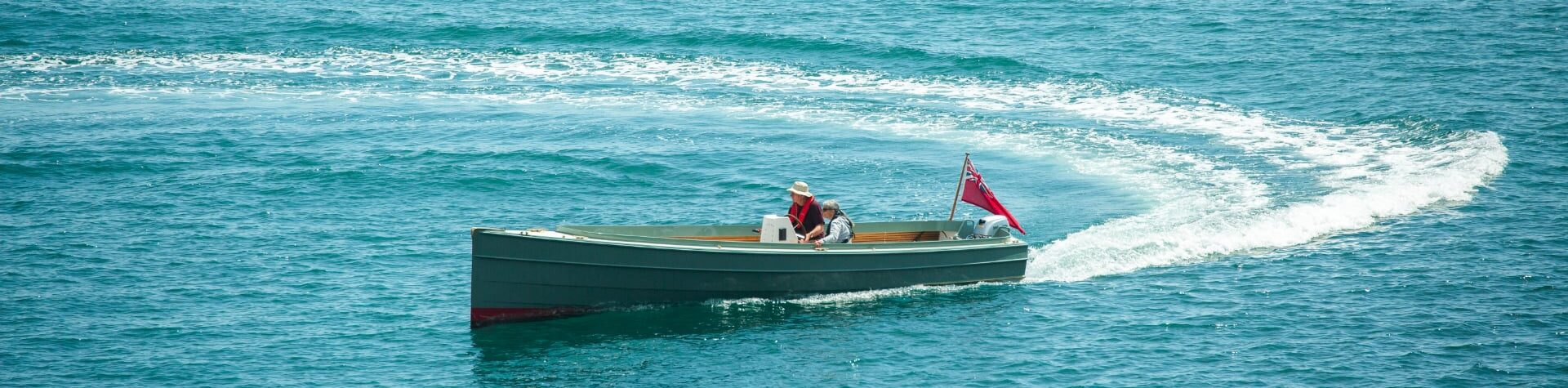
The first shows our 2012 test vessel ‘GRETA’ at maximum speed about 10 knots (as seen on our opening page).
LOA: 8.0m, Beam: 2.1m, Displacement (light): 800 kgs, Power: 1 x 14 hp (10.5 kw) 2 cyl. BETA Diesel, Max speed: 10 kn.
(Normal cruising speed about 9 knots).
The second is of our 2017 test vessel ‘WILHELMINA’ at maximum speed of about 11.5 knots:
LOA: 9.5m, Beam: 2.5m, Displacement (light): 1,800 kgs, Power: 1 x 23 hp (17.2 kw) 3 cyl. BETA Diesel, Max speed: 11.5 kn.
(Normal cruising speed about 10 knots).
The Third example is of the 2007 ‘ELEKTRA’ – First of a series of boats commissioned by Pattison Boatworks, Lake Windermere, UK.
LOA: 7 m (23 ft) ‘ELEKTRA’ – All electric day boat. 350 Kgs of Lithium Phosphate batteries supplying 2 x 12 Kw Lynch motors.
Max speed: 15 knots = range 15 miles (Speed/Length ratio = 3.2).
Economical cruising speed 10 knots = range 70 miles (Speed/Length ratio = 2.1).
This illustrates the importance of keeping in the ‘Swift’ Speed/Length range. Driving this hull at a ‘Fast’ speed is clearly not efficient.
Some testimonials from existing and future ‘LDL’ users…
“For us the Rangeboat 39 gives us the base to explore the Med allowing to cover distances in reasonable time at a very low fuel consumption.
We talk still about “a little more than 1l of diesel/nm at 11kn”. People usually will not believe you when reporting this. Neither the speed not the consumption!”
Hubert Kleis, owner of Rangeboat 39 “LUZY” (Germany)
“So this led me to think that our ideal boat would have a displacement hull with a max speed of around 12-knots, no hard chine forward, and a decent fuel economy of around 1-litre per mile or a little over … Congratulations – you’re a visionary! And with the cost of fuel rising …..”
Roger Lean-Vercoe – Chairman ‘Superyacht Awards’ (also owner of a Merry Fisher 855).(UK)
“It is no coincidence that RANGEBOAT’s have been purchased by the likes of Bruno Dubois and Dominique Marsaudon and (recently) Patrick Morvan. (all well-known professional French sailors)”
Nigel Irens
“I always hated the Motorboats; those which sail by you at full speed while you try negotiate a puff of wind! You know, those noisy beasts which hit and crush, kill each wave….and trigger your anger and hate….
We dream of Nigel Irens elegant solutions. Boats we will be proud of! Boats which will replace our sailboats in our dreams and on our bedside table….”
Bruno Troublé – well know professional sailor and organiser the Louis Vuitton Pacific Series and Louis Vuitton Trophy